HIGHLY TECHNICAL is for curious leaders and data enthusiasts. Get jargon-free insights, industry trends, relatable case studies, and smart tips to stay ahead of the curve. Perfect for anyone looking to turn data into action—plus, a little nerdy humor along the way!
Share
HITECH: What you need to know about open-source, open-weight v. proprietary AI
Classes at the Omaha Data Science Academy begin September 21st. If you're paying really close attention, you might have noticed a slight change in our start date. Originally, we were going to kick off the Fall Semester on the 14th, but it turns out, a couple of our ODSA instructors are speaking at conferences that week!
Each of our instructors is a practicing professionals actively working in the fields they teach, helping ensure students learn current tools, technologies, and professional practices.
All classes and certificate programs emphasize applied technical instruction, practical skill development, and industry-relevant competencies aligned with workforce needs.
The answer varies, but according to Gartner, open models will jump from today's 10% to 50% of use cases for businesses in the next two years.
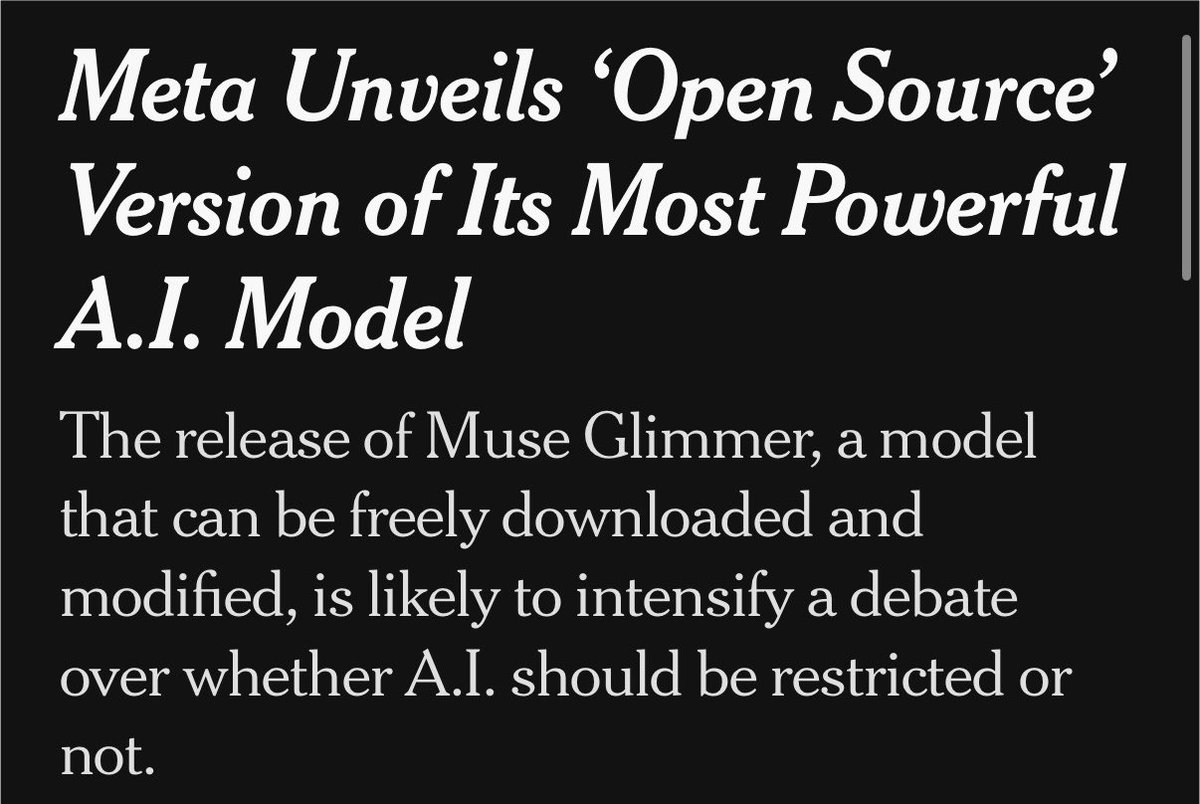
Chances are good your company will have to answer this question sooner than later. So today we're covering what an open-source model is, how it's different than open-weight (so you don't confuse the two like the NYT did...), and a few thoughts directly from our CDO, Tyler Hayes.
As Gary Marcus explains, an open-weight model is only sharing the metaphorical cake, not the recipe. And while you may be able to decorate it with icing and fruit, "you can’t change the raw ingredients that went into the cake itself."
More specifically, an open-weight model shares the candidate or base model, but not the process of how it was trained or the data it was trained on.
Earlier this month, Meta announced Muse Glimmer, its new open-weight model. Google also offers the open-weight Gemma family.
Proprietary Models
Models from OpenAI and Anthropic are proprietary models that cannot be freely used, modified, or studied.
Open source is the ideal, open weight is still strongly preferred to closed, and closed models are useful when their performance earns the tradeoff.
As our Chief Data Officer, Tyler Hayes explains:
"Often, a company's starting line is to build on the biggest, most private models you effectively can. Many times that means you are using a Anthropic or OpenAI frontier model (but you should still have data privacy agreements in place with them!) and that is OK.
Then we work with clients to migrate to a cheaper, more private, more cost efficient model (this typically puts us in the open weight section, but if a fully open source model meets our needs we will absolutely use it when we can).
We’re not ‘open source or nothing’ people.
Fully open-source models are the ideal because their transparency and freedom line up most closely with our values. But open-weight models still give companies many of the things that matter in practice, including self-hosting, customization, stronger data control, and less dependence on a single vendor. We would choose a good open-weight model over a closed model almost every time. Open source is our north star, but not a requirement.
AT&T is using both open-source and open-weight models, including models from China. Open-models currently power about 25% of AT&T's 45 billion daily AI tokens used across more than 1,000 company-wide AI users.
Chief Data and AI Officer Andy Markus says he expects open-models to eventually account for over 70% of all AI usage.
Why is AT&T betting big on open models?
There are two main reasons: cost and privacy.
Markus shares that "switching from closed, proprietary AI models to open models has already resulted in savings of 80% to 90% for AT&T in certain applications."
It's important to note, these savings come from open models combined with smart routing, not model openness alone. AT&T's custom-build "smart router...automatically picks the most cost-effective model for a specific task." (This is one piece of our Inference Management services our team spoke about at CANalytics 2026)
Switching to more open-source models has also given AT&T more control over where their data flows, who has access to it, and if it's used to train someone else's models.
Another benefit of open models is that they can be run on AT&T’s own data centers rather than rented infrastructure from a cloud-computing provider—a setup that trims AI costs even further.
Your AI questions might start with "where do we build?" but the more important question might be "who owns our AI infrastructure and how much flexibility do we have over it?"
Monkey see, monkey do. That's a 70+ year old goal for robotics that has stayed just out of reach.
You can teach a human (and some animals) a task just by demonstrating it once or a few times. You see someone use a dust pan, and you quickly understand how to use a dust pan. And when there is no dust-pan available, it's common to make your own from a piece of carboard or paper. In robotics-speak, that one-shot or few-shot learning.
What matters from a capability standpoint is immediacy and generality: can the model learn a new task quickly and generalize to new situations? For physical tasks, this level of intelligence demands both broad abilities in comprehending task intent, as well as adapting in real time, closed-loop, to the unexpected variation of the real world. - Generalist
This month a frontier AI research and product company, Generalist, released GEN 1.5 a new foundational model that embodies the beginning stages of one-shot learning. See it in action.
"Super cool for robotics, will be interesting to see if they follow a similar curve to LLM growth and speed of improvements. Assuming the hardware side of the house will be the limiting factor" - Tyler Hayes, CDO at CAN
Help us choose a name
It's about time we found a name for our Quarterly Data Science Meetup.
My top idea right now is: Data Unplugged
"Unplugged" because you aren't showing up with a notebook, looking to learn the newest skill (if you want to learn with us, enroll for the fall semester at the ODSA.) Instead, our quarterly meetup is where data scientists and AI enthusiasts come to break bread and clink classes. Where you come to actually talk to others in your field, because as one attendee said "its hard to find people who like the same things as you."
Omaha has a lot of great meetups, we've been to most of them. They are great in their own ways, but often, there's not much chatting. Maybe a few hi-hellos as you're walking in or grabbing food. And 10 minutes of small talk, usually to people you already know. But we've noticed, once the presentation is done, people skedaddle pretty quickly.
That's why we don't organize our meetups around a specific topic. Our quarterly meetup is for meeting and mingling. And its free! Beer and snacks on us!
Thank you to everyone who made it to our Q3 meetup!
You're receiving this email because you signed up to receive our Data Science resources from Contemporary Analysis or the Omaha Data Science Academy. If you would like to stop getting our weekly newsletter, but stay on our other lists, update your Preferences or Unsubscribe
1402 Jones Street, Omaha, NE 68102
Become HIGHLY TECHNICAL in 5 Minutes a Week
Created for the data-driven, by practicing data scientists
HIGHLY TECHNICAL is for curious leaders and data enthusiasts. Get jargon-free insights, industry trends, relatable case studies, and smart tips to stay ahead of the curve. Perfect for anyone looking to turn data into action—plus, a little nerdy humor along the way!
Read more from Become HIGHLY TECHNICAL in 5 Minutes a Week
Presented by Contemporary Analysis & Omaha Data Science Academy A Weekly Upskill for Yourself, Your Data, Your Team October 22, 2026 Issue 134 This is week 3 where we breakdown the conversations we're having with clients that we wish all data and AI leaders understood in October 2026. Next up: Model testing for the purpose of changing models. When your team asks, "Is the new AI model better? Should we switch?" You don't want to be stuck saying, "I don't know. We don't have a way of knowing."...
Presented by Contemporary Analysis & Omaha Data Science Academy A Weekly Upskill for Yourself, Your Data, Your Team October 15, 2026 Issue 133 This is week 2 of 5 where we breakdown the conversations we're having with clients that we wish all data and AI leaders understood in October 2026. Next up: AI Model Deprecation A common myth about AI models is that they operate similarly to software products. Take Microsoft Windows or Apple iOS. Once you download the operating system to your phone or...
Presented by Contemporary Analysis & Omaha Data Science Academy A Weekly Upskill for Yourself, Your Data, Your Team October 8, 2026 Issue 132 This is week 1 of 5 where we breakdown the conversations we're having with clients that we wish all data and AI leaders understood in October 2026. First up: Vendor lock Vendor lock isn't new, but we are starting to see it happen in AI more and more. Vendor lock is when a company selects a software, tool, or AI vendor and builds systems accordingly....